
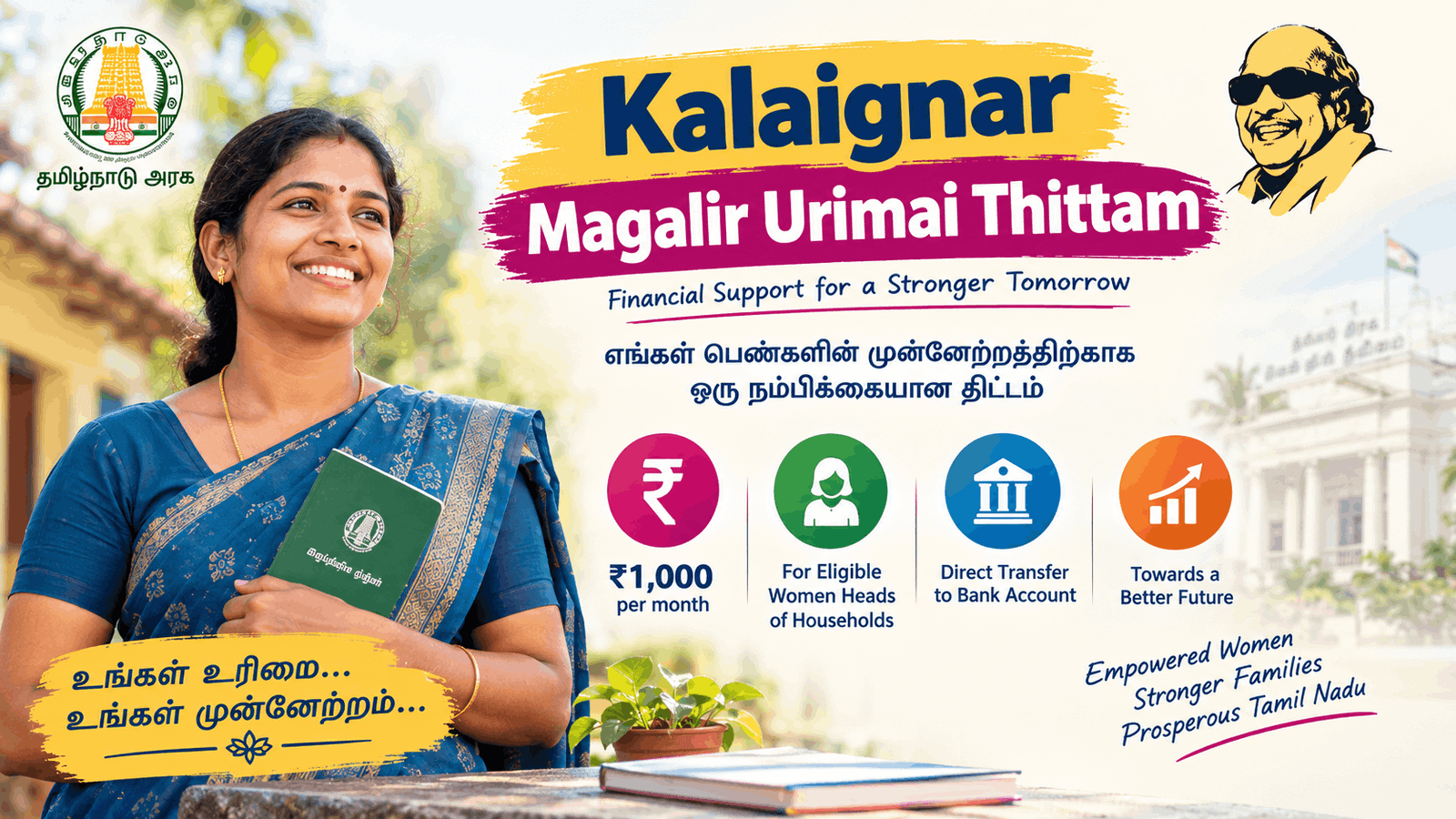
For many families, even ₹1,000 can make a difference. It can help with groceries, school-related expenses, medicines, transport, household needs, or simply give a woman a little more control over how money is used at home.
This is the basic idea behind the Kalaignar Magalir Urimai Thittam (KMUT), a Tamil Nadu government scheme that provides monthly financial assistance to eligible women heads of households.
But if you are hearing about the scheme for the first time, you may have very practical questions:
Who can receive the money? How much is provided? How can I check my application? What should I do if I have not received the amount?
This guide explains the scheme from a beneficiary’s point of view.
What is Kalaignar Magalir Urimai Thittam?
Kalaignar Magalir Urimai Thittam is a Tamil Nadu government welfare scheme launched to provide financial assistance to eligible women heads of households.
Under the scheme, ₹1,000 is provided every month to eligible beneficiaries through their bank accounts. Tamil Nadu government budget and official statements have reported that around 1.15 crore women are receiving the monthly assistance.
The scheme was introduced with a simple objective: provide women with a regular source of financial support that they can use according to their family’s needs.
And that distinction matters.
This is not necessarily money meant for one particular expense. For a woman managing a household, the choice of where that ₹1,000 is most useful can change from month to month.
Why can ₹1,000 a month matter?
Imagine a household where several small expenses appear throughout the month.
One month it could be groceries.
The next month it might be a child’s school requirement. Another month, a medical expense or electricity-related household cost may become more important.
A regular payment gives the beneficiary some flexibility.
The Tamil Nadu government has also stated that the assistance can help women meet daily expenses and build savings.
So, when looking at the scheme from a woman’s perspective, the important point is not simply the amount.
It is the regularity and direct access to financial support.
Who is the scheme meant for?
The scheme is specifically focused on eligible women heads of households.
However, being a woman or having a ration card does not automatically mean that every applicant will qualify. Eligibility is determined under the scheme’s rules and the government’s verification process.
This is important because many online articles mix old eligibility information, unofficial explanations, and information from other welfare schemes.
If you are applying, don’t rely only on a random checklist found online. Check the latest instructions provided through Tamil Nadu government channels.
How does the money reach the beneficiary?
The assistance is transferred directly to the beneficiary’s bank account through the government’s payment system.
This direct-transfer approach is one of the important features of the scheme. Official Tamil Nadu documents state that the ₹1,000 monthly assistance is deposited directly into beneficiaries’ bank accounts.
For the beneficiary, this means that keeping the bank account details correct and active is important.
If you are expecting a payment but have not received it, don’t immediately assume that your application has been rejected. There can be issues involving verification, bank details, account status, or beneficiary records.
How can I check my Kalaignar Magalir Urimai Thittam status?
Tamil Nadu’s official e-governance service portal lists a dedicated service for “Tamil Nadu Kalaignar Magalir Urimai Thittam Scheme – KMU-103 KMUT Check Status.”
This is useful when you want to check the status of an application instead of depending on unofficial websites or social-media posts.
Tip: Before checking your status, keep the relevant application or family-card details available. Enter information carefully and use only official government portals for sensitive information.
What if I have not received the ₹1,000?
This is probably the question many beneficiaries care about most.
If you were expecting the monthly assistance and it has not reached your account, take a step-by-step approach:
1. Check your application status
First, find out whether your application/beneficiary status is active, pending, rejected, or requires further action.
2. Check your bank account
Make sure the account connected with the scheme is active and that the relevant banking details are correct.
3. Check whether your beneficiary details are correct
Errors in personal or family information can create problems during verification or payment processing.
4. Use official grievance or support channels
If the online status does not explain the problem, approach the appropriate government office or official support channel rather than paying an intermediary.
Never pay a person simply because they claim they can “release” your Magalir Urimai Thogai.
Is the scheme available through an online portal?
Tamil Nadu’s e-Sevai ecosystem provides online government services, and the official service list currently includes the KMUT status-check service.
However, there is an important difference between:
- checking your status online, and
- submitting a new application or correction request.
The availability and process for applications can change when the government opens new application rounds or expands beneficiary coverage.
Therefore, before submitting personal information, check the latest announcement on an official Tamil Nadu government website.
What should you keep ready?
If you are applying, checking, or correcting your details, it is sensible to keep commonly required information accessible, such as:
- Family/ration card details
- Aadhaar-related details where officially required
- Bank account information
- Mobile number
- Application or acknowledgement details, if you already applied
The exact documents required can depend on the current process and your particular case.
Do not upload documents to a website simply because it uses the words “Kalaignar Magalir Urimai Thittam.”
Look for an official Tamil Nadu government domain before entering Aadhaar, bank, OTP, or other sensitive information.
A small monthly amount can mean a practical choice
Government schemes are often discussed using large numbers—crores of beneficiaries, large annual budgets and administrative targets.
But a beneficiary experiences the scheme differently.
For one woman, ₹1,000 may help buy household essentials.
For another, it may reduce the pressure of a recurring expense.
Someone else may decide to save part of it.
That is why the most meaningful way to understand Kalaignar Magalir Urimai Thittam is not just by looking at the total amount distributed. It is also by looking at the financial choice given to an individual woman each month.
The Tamil Nadu government’s 2025–26 budget documents allocated ₹13,807 crore for the scheme.
Before you apply: 5 things to remember
1. Use official information.
Scheme rules and application procedures can change.
2. Don’t assume eligibility.
Check the current criteria applicable to your household.
3. Keep your details accurate.
Incorrect information can create verification problems.
4. Protect your banking information.
Never share your OTP, PIN or internet-banking password with someone claiming to process the scheme.
5. Don’t pay unofficial agents.
A person asking for money to “guarantee” approval should be treated with caution.
Final thoughts
Kalaignar Magalir Urimai Thittam is ultimately about something very practical: regular financial support reaching women who meet the scheme’s eligibility requirements.
If you are considering applying, don’t let complicated terminology stop you.
Start with the official eligibility information, keep your documents and bank details ready, submit information carefully, and check your application through an official channel.
And if you are already a beneficiary, regularly checking your payment and beneficiary status can help you identify problems early.
The best way to approach any government welfare scheme is simple: Know the rules. Use official channels. Protect your information. And keep your records safe.